
- orianeguenievrearmidaaston
-
 Jumat, 25 Januari 2013
 -
 0 Comments


Free Ebook Desert Victory: The War for Kuwait, by Norman Friedman
By starting to read this publication immediately, you can quickly discover the proper way to make far better top qualities. Use your leisure time to read this book; even by web pages you could take a lot more lessons as well as motivations. It will not limit you in some events. It will certainly free you to constantly be with this book every single time you will certainly review it. Desert Victory: The War For Kuwait, By Norman Friedman is now available below as well as be the initial to obtain it now.
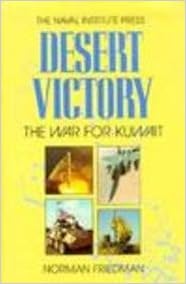
Desert Victory: The War for Kuwait, by Norman Friedman

Free Ebook Desert Victory: The War for Kuwait, by Norman Friedman
Desert Victory: The War For Kuwait, By Norman Friedman. Is this your extra time? Just what will you do then? Having extra or spare time is extremely outstanding. You can do everything without force. Well, we mean you to spare you few time to review this book Desert Victory: The War For Kuwait, By Norman Friedman This is a god book to accompany you in this spare time. You will certainly not be so tough to understand something from this e-book Desert Victory: The War For Kuwait, By Norman Friedman Much more, it will help you to obtain far better information and experience. Also you are having the terrific tasks, reviewing this e-book Desert Victory: The War For Kuwait, By Norman Friedman will not add your thoughts.
How can? Do you think that you do not need enough time to go with purchasing publication Desert Victory: The War For Kuwait, By Norman Friedman Don't bother! Merely sit on your seat. Open your gizmo or computer and be online. You can open up or check out the link download that we offered to get this Desert Victory: The War For Kuwait, By Norman Friedman By this way, you can get the on the internet book Desert Victory: The War For Kuwait, By Norman Friedman Reviewing the publication Desert Victory: The War For Kuwait, By Norman Friedman by on-line could be actually done conveniently by waiting in your computer system as well as kitchen appliance. So, you could proceed whenever you have spare time.
And why this publication ends up being so popular is that the here and now book originates from the prominent writer on the planet. Many individuals appreciate the literary works concerning whatever. The topic to discus and also provide is additionally much related to the life. So, you can be part of their mind as well as believed that think of this incredible publication. To evoke just what is informed by Desert Victory: The War For Kuwait, By Norman Friedman, you can begin to read it currently.
If you still require more books Desert Victory: The War For Kuwait, By Norman Friedman as referrals, visiting search the title and theme in this website is offered. You will discover more lots publications Desert Victory: The War For Kuwait, By Norman Friedman in various self-controls. You could additionally as soon as feasible to review the book that is already downloaded and install. Open it and also conserve Desert Victory: The War For Kuwait, By Norman Friedman in your disk or gadget. It will certainly reduce you wherever you require guide soft data to read. This Desert Victory: The War For Kuwait, By Norman Friedman soft file to read can be referral for every person to boost the skill and also capability.
Product details
Hardcover: 435 pages
Publisher: Naval Inst Pr; First Printing edition (July 1, 1991)
Language: English
ISBN-10: 1557502544
ISBN-13: 978-1557502544
Product Dimensions:
5.8 x 1.5 x 8.8 inches
Shipping Weight: 1.9 pounds
Average Customer Review:
3.3 out of 5 stars
4 customer reviews
Amazon Best Sellers Rank:
#2,911,151 in Books (See Top 100 in Books)
This book should have been written 2 years later. It's hard to offer analysis when we're still chanting "USA, USA, USA!" and have yet to put Lee Greenwood back in the freezer. Incredibly bland. Overly focused on the US Navy. Meaningless conclusions and lessons learned. I take it back...this book shouldn't have been written at all.
Military history comes in various flavors, just like ice cream. On one side of the spectrum, you can find books that analyze the wider strategic and tactical aspects of a conflict, with emphasis on politics and the commanders on both sides. On the other, you find books that not only deal with the "big picture" but also strive to show the conflict from the combatants' vantage point.Desert Victory is one of those "big picture" books that focuses more on the strategies and tactics used by both Iraqi dictator Saddam Hussein and President George H.W. Bush and their respective military commanders. Written shortly after the war (it was published in the fall of 1991) by noted historian and military analyst Norman Friedman, Desert Victory traces the roots of the first Persian Gulf War to Saddam's rise to power in the late 1970s, his disastrous foray into Iran in 1980, the misguided policies of moderate Arab countries and two U.S. administrations to support Iraq (a mostly Shi'a Muslim country ruled by a Sunni Arab minority) against the perceived threat from Shiite Iran and the genesis of Saddam's invasion of the tiny but oil-rich emirate on his southern border.Friedman explains the events of the Persian Gulf War ably and intelligently, analyzing the tactics, strategies and forces employed by both sides. It is a well-researched account of both Operations Desert Shield (the buildup) and Desert Storm, with particular attention being paid to the diplomatic and military forging of the coalition that would liberate Kuwait in February of 1991.However, readers who prefer the "Cornelius Ryan/Stephen Ambrose" approach are going to be disappointed. There are few eyewitness anecdotes in the text, and the prose does tend to be rather dry.
The outcome of a war between the world's biggest, most advanced power and a nation -- if that's what Iraq is -- of mostly illiterate barley farmers should not have been in doubt. For many it was.Will Americans, as a group, do any better at what Norman Friedman calls 'lessons learned and mislearned' after the fact? Maybe a little. Friedman's 'Desert Victory' is more sensible than 99% of the prewar commentary.However, it is less a quick history of the war than a summary of 1980s military philosophy, a subject Friedman has been covering all along. Thus, for every paragraph about events in the gulf, we get a couple of pages of instruction in elementary strategy and tactics. This is not a criticism: If we learned anything for sure from this little war, it is that the American public understands next to nothing about the practical problems of using force and violence in international affairs.'Perhaps the most interesting lesson of the war,' writes Friedman, 'is that the sort of conventional analysis used to project Iraqi performance failed to take into account the structural problems inherent in Saddam's Iraq.' He is not writing about hysterical journalists or frightened civilians but about the experts in the Defense and State departments and the National Security Council. They failed to correctly estimate the likelihood that Iraq would be an aggressor or the ability of Iraq to mismanage what Friedman likes to call 'national assets.'While noting the failure, Friedman fails to offer a cure; yet it was obvious to anyone who has studied the history of the 20th century that a state structured like Saddam's was likely to be adventuristic and that a society like Iraq's -- that is, a medieval society -- could not seriously engage modern states on any grounds except ideological and propagandistic. Didn't we learn anything in Vietnam? Evidently not.Well, maybe George W. Bush learned a negative lesson from Lyndon Johnson. After making the decision to use force, he let the professionals decide how. Friedman says many in Washington were 'irked' by that. No doubt.The best part of 'Desert Victory' is Friedman's complex analysis of the factors arguing for and against use of force. The apparent international unanimity need not be taken too seriously, but Bush was a clear winner in the propaganda battle.Concerning the actual fighting, Friedman's touch is much less certain. In large part this is because he is wedded to a Reagan-era Navy policy of using aircraft carriers to defeat the world's largest land power -- surely a more dubious concept than Friedman thinks, although probably we'll never have to put it to the test.Anyway, he attempts to use the gulf results to prove the idea has merit, but the circumstances were hardly relevant. America's big flattops probably saved Saudi Arabia; and even if they didn't, we didn't have anything else that could have. Score one for Friedman and the Navy.But if you read his accounts carefully, a lesson of the gulf becomes apparent, one Friedman does not learn. Antiship missiles are so dangerous to carriers that, against a competent opponent, they would have to operate so far offshore that their combat options would be few. Even against the incompetent Iraqis, the American carriers were wary. Score one against Friedman and the Navy.Of course, the big story was the air war. Friedman depicts this as much more difficult operation than we were told at the time.First, there was a shortage of bombs.Second, reconnaissance was very deficient.Third, even though the Iraqi air defense was very bad, its mere existence ate up a large proportion (nearly half?) of the American air effort.And, of course, most of the bombs didn't hit anything. One quarter of the bombs were dropped by B-52s, which cannot hit anything except by luck.To damage a target, an iron bomb has to hit within about 100 feet. It doesn't take a genius to figure out that a pilot traveling at 500 miles per hour cannot know his position within 100 feet within any usable interval of time, and therefore he cannot aim.The Air Force learned this after World War II, when a survey found that more than 99% of bombs missed, despite heroic efforts to aim. The logical conclusion would have been to stop bombing, which was too much to ask; but the military did adopt the next most logical conclusion -- it stopped aiming.Friedman puts it delicately: 'In many cases . . . accurate weapon delivery was impossible except at low altitude.'Certainly, America went to war with the finest armed forces that deficit financing could buy, and the equipment and the people performed very well, although the combat units that depended on making up strength from the Reserves never did get going.The real triumph was delivering a mighty army halfway around the world in just a few months. Thank Jimmy Carter for that.'Desert Victory' is strongly opinionated, well backgrounded and clearly expressed. Even when Friedman is wrong -- and he certainly is in his admiration for Gen. Norman Schwarzkopf's switching of his front -- he is worth reading.An interesting omission from his book is a discussion of women in the armed forces. For theorists like Friedman, that battle was fought long ago. The women won.
Friedman is one of America's best military autohrs and historians. His FIFTY YEAR WAR is the best account of the strategies and politics of the cold war. This DESERT VICTORY is an excellent, though somewhat short, review of the Kuwait war.I'm rather hoping Friedman writes an account of last month's Iraq war ASAP, it is sure to be the best of the dozens of books sure to come out of the war.
Desert Victory: The War for Kuwait, by Norman Friedman PDF
Desert Victory: The War for Kuwait, by Norman Friedman EPub
Desert Victory: The War for Kuwait, by Norman Friedman Doc
Desert Victory: The War for Kuwait, by Norman Friedman iBooks
Desert Victory: The War for Kuwait, by Norman Friedman rtf
Desert Victory: The War for Kuwait, by Norman Friedman Mobipocket
Desert Victory: The War for Kuwait, by Norman Friedman Kindle


0 komentar: